More dictionaries (and other things)! I went to a bookstore in Schaumburg last month and bought four dictionaries and a thesaurus. Let's dive right in.
Dictionary #1: Pocket Oxford Dictionary
I know I haven't really talked much about Oxford dictionaries on this blog so far, but there's content coming about them somewhere down the road. For now, let's take a look at this dictionary.
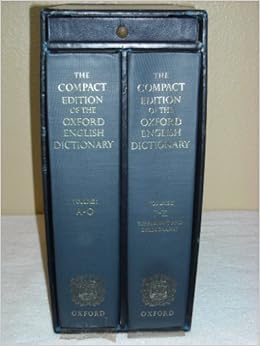
For one, I think it's interesting that it's called a pocket dictionary that I don't think any reasonable pocket could fit. But, given the size of the mammoth "Compact Edition" of the OED (Oxford English Dict.), it's not surprising that the one I bought has that name.
This is the "Compact Edition" of the OED. I'm not joking. The micrographic printing necessitates the use of a magnifying glass, which is (usually and hopefully) contained in the drawer. Good luck if it's missing. Mwahaha. Check out my image sources for more if you're interested: Left and Right.
Here are some images of the Pocket Oxford Dictionary bought on June 7.
 |
| Front cover, with AA battery for scale. |
 |
| Opened with view of front and back covers, with AA battery for scale. |
 |
| Spine without jacket. |
 |
| Front cover without jacket. The back cover looks the same. |
 |
| Sample image of contents, so you get an idea of how compact it is. |
 |
| Printing right inside the covers. Beautiful artwork. |
 |
| Inside right jacket flap. Interesting idea and weird criteria for response... |
 |
| Inside left jacket flap. |
The appendices are interesting and practical, too. Take a look below (and above at the Table of Contents).
I really like the Pocket OED for its easy-to-handle size, the feel of the paper (it just feels so crisp, since it was pretty much unused when I got it), and the concise but richly informative definitions, though I wish the binding felt a little bit more solid. I feel like it's going to fall apart if I hold it the wrong way. Anyway, take a look at some sample definitions.
 |
| Very simply stated etymologies in this entry. |
 |
| Great distinction between related words (meteoroid has yet to light up, meteor is on fire, meteorite has landed). |
 |
| The way that the connotation of the word is described is very clear. |
 |
| The nice thing about these entries is the distinction between related words and phrases that a discoverer of such words might confuse when first learning them. I love the etymologies (have I said that already?) and the specificity of which churches the word is associated with (italicized at top) is cool. |
 |
| The colloq. label and definition give you a sense of what the word feels like to be used (you might use it to describe a riot, but not a loud jackhammer). |
Isn't it great? The entries have very crisp definitions and provide a lot of information without being overwhelming. It's a handy little thing, and the fact that you would really only need this dictionary -- not a huge mass of paper -- to figure out what you're trying to find makes this convenient work even more valuable for practicality.
Dictionary #2: Merriam-Webster and GARFIELD Dictionary
This is a great piece of humorist work as well as a curiously synthesized dictionary with a cool layout and assimilation of the Garfield comics. Take a look at the outside.
Garfield might (certainly) have been used as a marketing technique, and it sure worked on me! But I think that it's an awesome idea because it'll get kids to pick up the dictionary and flip through it for fun, and the dictionary can act simultaneously as a source of entertainment and learning. And I love the comics they chose! See some entries and comic strips from the dictionary below.
 |
| Comic for "autumn." |
 |
| Comic strip for "avoid." |
 |
| Comic strip for "chili powder." |
 |
| Comic strip for "crawl." |
 |
| Entry for "crawl." Notice that Garfield's face appears only next to the sense that was used in the comic strip. |
 |
| Comic strip for "etiquette." |
 |
| Entry for "hydrogen." Just felt like including it. |
 |
| Some entries I found interesting... the three senses of "quintuplicate"... |
 |
| Comic strip for "rabid." |
 |
| Entry for "rabid." This one isn't as concretely stated as the one for "crawl," but still a cool way to incorporate Garfield into the dictionary. |
 |
| Comic strip for "slob." Don't you love this humor? |
This is one page that makes the dictionary, and it makes me really happy. It's the first page in the dictionary, just behind the front cover. :)
Overall, a very fine, floppy, functional, and friendly dictionary "featuring the world's feistiest and funniest feline" for children and adults alike!
Not-Dictionary #3: Merriam-Webster Pocket Thesaurus
I know I generally talk about dictionaries on this blog, and this post is even called a Dictionary Haul, but this is one of the reference works I bought on the trip. A Merriam-Webster Pocket Dictionary has passed hands many times within my immediate family, and when I started collecting dictionaries, I was given possession of it. Naturally, as soon as I saw the pocket thesaurus, I knew it would be a good pair to have a dictionary-thesaurus pair. I have a similar pair with the abridged collegiate editions of both books.
There isn't too much else to say about this one. It's pretty recently published and there isn't really anything crazy, so there you go. Moving on.
Dictionary #4: Dictionary of Symbols
Here's a cool "dictionary" that I found in the reference section... even though I would argue it didn't really belong there. More for the learning and "interestingness" factor.
This is not a typical dictionary in that it looks like a real book, rather than a hunky tome of an encyclopedic reference work. It's an interesting idea and the organization is pretty good. It's more of a here-learn-about-some-cool-things-in-an-organized-way sort of book than a legitimate dictionary, although it is organized much like a dictionary.
 |
| Sample content image. |
The title might be a little misleading if you don't actually see the book, but I actually read a few pages out of this like you might read some pages out of a non-scary kids' encyclopedia (if such a thing exists) -- basically where there's a few facts about something in a couple of paragraphs presented concisely.
One thing I found confusing: if you know what a symbol looks like but you don't know what it's called -- say, for example, the staff with two snakes around it -- how are you supposed to find it? Do you just flip through the whole book hoping there's an image of it? Because it seems like that's the only option you have. In any case, it was called a dictionary, and I like it, so why not include it? :)
 |
| It's called a "caduceus." |
Dictionary #5: American Heritage Dictionary, Second College Edition
Well, it's another American Heritage. What can I say? It looks awesome, although I wish that the jacket wasn't torn. I don't want to alter it with book repair tape, so I'll just be careful when handling it (as anyone should be with all old books).
 |
| Interesting way to present all the dictionary's features. |
I really like the color of the dictionary. It's so stately and professional, and it also feels patriotic and American with the navy blue and the bright red in the eagle logo. And the quality content inside is nothing less than you'd expect from an AH dictionary.
 |
| Damage to the jacket. |
That it is a college edition must mean there's something different about it that just a normal AH. So, I looked through the table of contents, and look at all the stuff in here.
This isn't just continuing James Parton's tradition of including nonlexical content. This is a full-on desk reference. There are all kinds of things in here that might be useful to a college students, not to mention the listings of universities.
 |
| The first couple of sentences describe the reason The American Heritage Dictionary was started. |
 |
| Biographical dictionary at back. |
 |
| The entry for my favorite composer is so short!! |
 |
| Geographical dictionary. |
 |
| This is different from the normal AHD. |
Here's a sample couple of pages of what the main content of the dictionary looks like:
Something I like about the dictionary is that on the first page (granted it's not the same paper) of the dictionary has a quick reference for illustrations and other references in entries within the dictionary. For example, the "anatomy" reference listed says to find the images at the entry (rather than a table or plates at the back of the dictionary where nonlexical information is often printed). It's great that the editors and creators thought about having such a reference right at the beginning to reduce confusion for users who are looking for information other than just definitions, which is the whole reason Parton decided to start up his own line -- to fix the usage problems and to bring back nonlexical information.

I was a little confused about why some of the thumb index labels were missing when I got the dictionary, but I didn't really question it because these dictionaries wear our and the glue that holds the labels in place can deteriorate. Four of the labels were missing, and I was able to find three of them stuck in between pages of the dictionary. The fourth one is lost... hopefully I'll find it at some point. But, the glue stick was able to intervene and (partially) save the day!
 |
| Normal tabs. |
 |
| Uh oh. They're missing! |
 |
| Gluing back one of the tabs. |
 |
| You can see where to place it because of the old glue (it's a little yellowed). |
 |
| Voila! |
To read more about the beginning of American Heritage, click here.
So, this is a cool dictionary, and the others (and the thesaurus) were pretty nice, too.
So, that's my post for today. Hope you enjoyed it! Follow my blog for updates and check back soon for more!


No comments:
Post a Comment